Tax
Read Time: 3 min
Underdiscussed Economic Cushions as War in Iran Continues
U.S. economic policy shifted from tariff austerity in 2025 to fiscal stimulus in 2026. The One Big Beautiful Bill Act that was enacted in Jul. 2025 included consumer and business tax cuts that were meant to offset the negative economic impact of the tariffs. Consumers have benefited from lower withholding, higher tax refunds, and lower tax payments in the 2026 tax season. Businesses are able to immediately expense capital goods expenditures, domestic research and development costs, and expenses from the building of new factories. While those business tax provisions were retroactive to Jan. 2025, we’ve seen firms really begin to take advantage of them this year. These tax provisions were expected to serve as a driver of U.S. economic growth in 2026, but instead have provided an economic cushion from the higher oil prices and other supply chain constraints that have resulted from the Iran conflict.
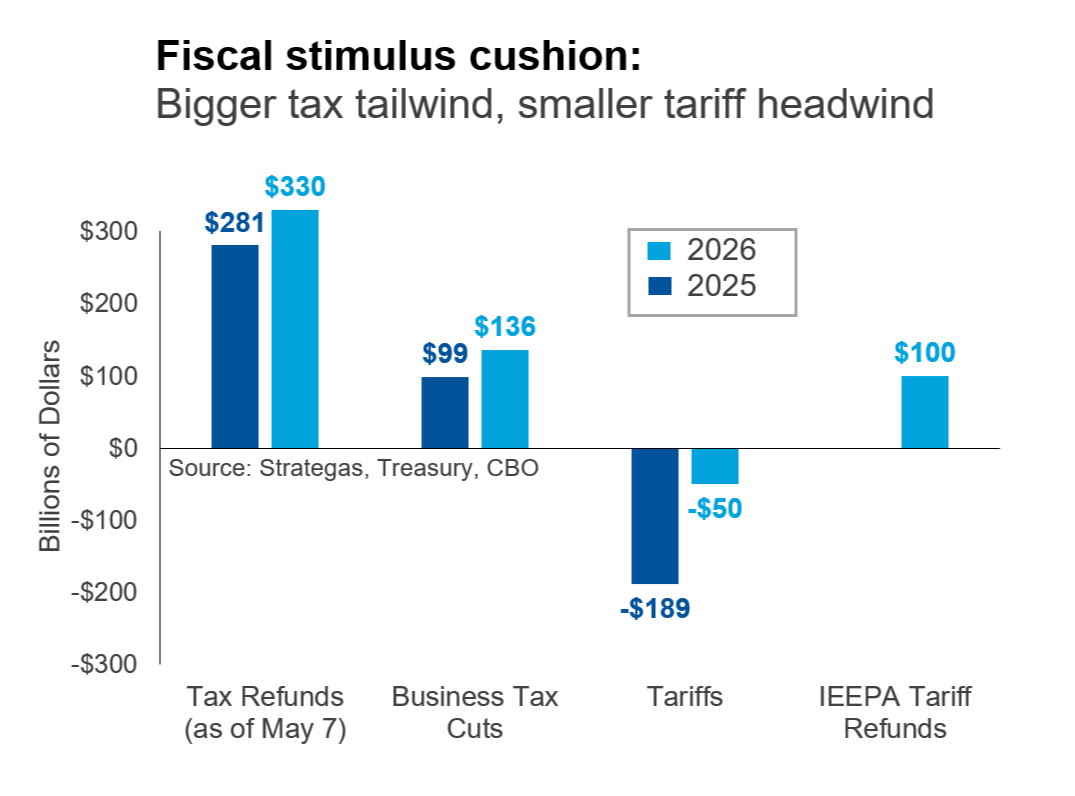
Tax refund season is over, but companies continue to benefit from business investment incentives. Reduced tariffs also provide an additional support. Higher tariffs in 2025 created a net tax increase on consumers. However, the effective tariff rate has fallen from a high of 11% in Oct. 2025 to less than 7% in Mar. 2026 as supply chains have adjusted and as President Trump’s International Emergency Economic Powers Act (IEEPA) tariffs were lifted after the Supreme Court ruled them unlawful. On top of that, companies will begin receiving IEEPA tariff refunds beginning the week of May 11, and roughly $100 billion of refunds are expected to be distributed over the coming months, providing another cushion for businesses (though it will have less of a direct impact on consumers). However, in July or August, we expect the White House to increase tariffs again as it concludes required investigations to impose tariffs under Section 301 of the Trade Act of 1974.
The big question: how long will the Strait of Hormuz remain throttled? Some oil and liquified natural gas exports have transited through the strait, but at nowhere near the levels we saw before the Iran conflict. However, the U.S. is seeking an end to the war. The U.S. has imposed a blockade outside the Strait of Hormuz to prevent ships from entering or leaving Iranian ports to put economic pressure on Iran to agree to a deal. The U.S. is also restraining from reengaging militarily. A deal has been elusive but both sides are getting closer, in our view. Of course, if Iran ends up with continued control over the flow of ships moving through the strait, that will impact global prices and supply. There is a lot of economic stimulus in the system, but if the conflict lasts months, U.S. consumers will feel the squeeze. That is also a concern for the administration as the U.S. heads into the midterm elections.


